Trading Confluences That Actually Improve Entries
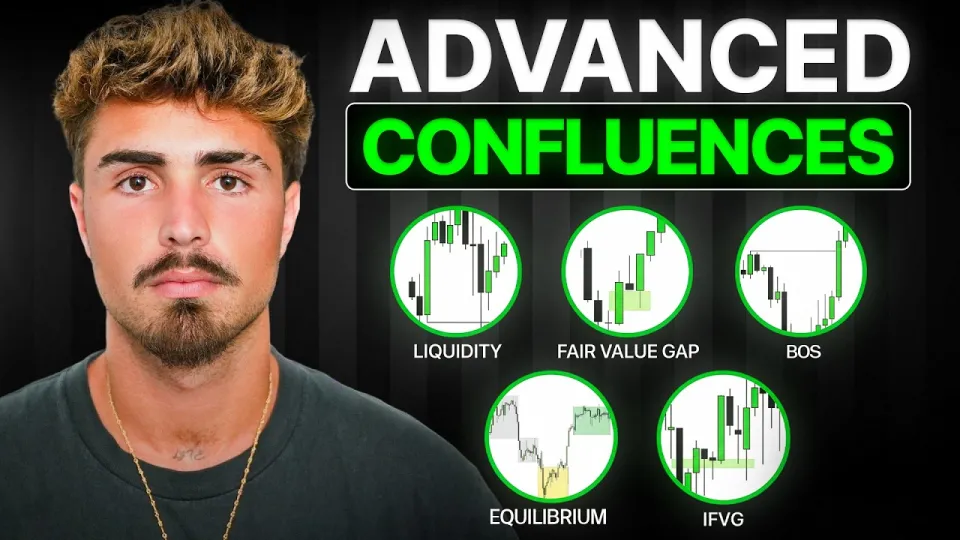
Video: Learn Every Trading Confluence In 18 Minutes
You can order the same kind of articles for your own video to boost it on YouTube and Google. Just message the Telegram bot @sat_sit_bot. Articles with your video embedded are written and posted by the bot itself — on popular topical sites (no ads). Free trial — 50 articles.
· based on the channel TJR
Trading confluences are independent signals that point to the same decision — liquidity, fair value gaps, inverse fair value gaps, equal highs and lows, and break of structure — and the practical skill is stacking two or three of them instead of chasing every one. A confluence only earns its place in a strategy if it changes the outcome of your entries and exits in backtests and live results. TJR's breakdown of the main confluence types in "Learn Every Trading Confluence In 18 Minutes" is a useful checklist for that work, and the full system behind it is available through the TJR Blueprint.
What a trading confluence actually is
A trading confluence is any piece of evidence that is logically separate from your primary signal but supports the same trade. If your entry trigger is a fair value gap, a confluence might be that the gap sits directly above a pool of liquidity, or that it formed right after a break of structure on a higher timeframe.
The word "separate" does the heavy lifting. Two indicators built from the same moving average, or a support level and a pivot that mark the same price, are one signal wearing two hats — they add confidence without adding information. Real confluences come from different market mechanics: order flow (liquidity), price inefficiency (gaps and imbalances), and market structure (breaks and equal levels).
A workable rule: if you cannot explain in one sentence why a confluence should make the trade more likely to work, it is decoration, not confirmation.
The five confluences worth knowing
These are the building blocks most price-action strategies are assembled from. Each one answers a different question about the chart.
- Liquidity. Resting orders cluster above equal highs and below equal lows, and around obvious swing points. Price is drawn to those pools because that is where stops and breakout orders sit. A liquidity sweep — price pushing through a level and snapping back — often precedes a move in the opposite direction.
- Fair value gap (FVG). A three-candle imbalance where the wicks of the first and third candle do not overlap, leaving a price range that traded only in one direction. Traders treat the gap as an area price may return to before continuing.
- Inverse fair value gap. When price closes fully through an FVG, the gap can flip roles: former support becomes resistance, or the reverse. An inverse FVG is a way to trade a failed gap rather than a respected one.
- Equal highs and equal lows. Two or more highs (or lows) at nearly the same price signal a level the market keeps defending — and a level that, once broken, tends to release stored orders quickly.
- Break of structure (BOS). A close beyond a prior swing high or low that changes the sequence of higher highs and higher lows (or the bearish mirror). BOS is the confirmation that direction has shifted rather than just paused.
How to stack confluences without over-filtering
Stacking confluences is a filtering problem, not a collecting problem: every condition you add removes setups, and past a certain point you remove the good ones too. A trader who demands liquidity, an FVG, an inverse FVG, equal levels and a BOS all at once may wait weeks for a single entry and then take it badly because it feels rare.
A more practical sequence:
- Pick one context signal — usually structure (BOS) or liquidity. This tells you which side of the market you are interested in.
- Pick one location signal — an FVG, an inverse FVG, or an equal-high/equal-low level. This tells you where in that context you want to act.
- Add a trigger only if your data shows it helps. Many traders find that a trigger improves win rate but cuts trade count so much that total expectancy barely moves.
- Test the combination. Compare win rate, average risk-to-reward and total return with two confluences versus four. If the extra filters do not improve expectancy after costs, drop them.
The honest test is not whether a setup looks cleaner on the chart — it is whether the filtered version makes more money per unit of risk over a large sample.
Where confluences fail
Confluences describe where liquidity and imbalance sit, not what price must do; a valid-looking stack can still fail, and it fails most often when the higher-timeframe context disagrees. An FVG on a five-minute chart inside a strong one-hour downtrend is a counter-trend long with extra steps. Equal lows that have already been swept twice are weaker magnets than fresh ones. A BOS that occurs in the middle of a range is noise, because there was no structure to break.
The other common failure is timing. A gap can be respected hours after it forms or skipped entirely; a liquidity level can be run in one candle or ground through over a session. Treating any confluence as a guarantee rather than a probability is how a good tool becomes a bad habit.
Risk control sits outside the confluence framework for a reason. Position size and stop placement decide whether a 40% win rate survives; no combination of gaps and breaks fixes a trade that is sized too large.
Questions traders ask about confluences
The most common doubts are about quantity and about discipline, and both come up constantly in discussions under TJR's videos. One recurring theme: viewers take extensive notes and still struggle to apply the material, because knowing the list of confluences is not the same as having a rule for which ones apply to their market and timeframe.
Another recurring theme is the expectation of a smooth path. Traders who have been at it for months describe losing money early, filtering out social-media highlight reels, and simply showing up every day — which is closer to how the process actually looks than any single perfect setup. The realistic framing is that confluences improve the quality of decisions you were already making; they do not replace screen time, a journal, or a tested plan.
A third theme is skepticism about market manipulation and about who is teaching what. That skepticism is healthy: verify every confluence on your own charts, in your own instrument, before risking size on it.
Useful links
- TJR Blueprint — the full system for becoming a profitable trader
- Indicators TJR uses daily
- Funded account raffle entry
- Alpha Futures funded accounts — 10% off
- Lucid Trading — 40% off
- Tradeify funded accounts — 30% off
- TradeZella trading journal
- HeroFX broker
Bottom line
Confluences are a filtering tool, and the traders who get value from them are the ones who test which filters pay for themselves. Start with structure and liquidity for context, add one location signal such as a fair value gap, and only keep a third or fourth condition if your own results justify it. TJR's 18-minute walkthrough is a compact map of the main confluence types — liquidity, FVG, inverse FVG, equal highs and lows, and break of structure — and a good starting point before you build your own rules. If you want the structured version, the TJR Blueprint is the channel's own path from checklist to a tested process.
Key takeaways
- A confluence is any independent signal that supports the same trade idea — liquidity, FVG, inverse FVG, equal highs/lows, or break of structure.
- More confluences is not automatically better: each added filter cuts the number of setups and can push a trader into analysis paralysis.
- Liquidity matters because price tends to seek resting orders above equal highs and below equal lows before reversing.
- A fair value gap marks an imbalance where price moved too fast for two-sided trade; an inverse FVG flips its role once price closes through it.
- Break of structure confirms a shift in direction, but only counts when it happens at a level the market has already respected.
Source: Learn Every Trading Confluence In 18 Minutes · Markdown version
Questions & answers
How many confluences should a trade have?
Two or three is usually enough: one context signal such as break of structure or liquidity, one location signal such as a fair value gap, and optionally one trigger. Adding more conditions reduces the number of setups, so keep an extra filter only if it improves expectancy in your own testing.
What is the difference between a fair value gap and an inverse fair value gap?
A fair value gap is an imbalance left by a fast move, where the wicks of the surrounding candles do not overlap. An inverse fair value gap is the same zone after price has closed fully through it, at which point traders watch it as a flipped level — former support acting as resistance, or the reverse.
Why do equal highs and equal lows matter in trading?
They mark prices the market has repeatedly defended, which is where stop orders and breakout orders tend to cluster. That makes them liquidity targets: price often sweeps them before reversing, and a clean break can release stored orders quickly.
Do confluences work without a tested risk plan?
No. Confluences describe where liquidity and imbalance sit, not whether a trade will win, so position sizing and stop placement still decide whether a strategy survives a normal losing streak. Treat confluences as a way to improve the quality of entries, not as a replacement for risk control or a journal.